The Unfolding Canvas: A Modern Guide to Stadium and Arena Lighting
The Vast Promise of the Empty Space
There is a unique silence in a stadium just before the house lights fall. It’s a space carved out of the night, holding tens of thousands of individual points of anticipation. For a lighting designer, this is not an empty void to be filled but a canvas of immense proportions. The modern tour is no longer about simply illuminating a performer on a distant stage. It’s about commanding an entire environment, painting with light on a scale that encompasses architecture, atmosphere, and the audience itself. This is the new art of spectacle: transforming a cavernous space into a shared, intimate, and unforgettable universe. The challenge lies in a set of core principles that balance technical mastery with pure storytelling.
Principle 1: Mastering Scale from the Front Row to the Nosebleeds
A stadium’s greatest asset—its scale—is also its greatest challenge. The task is to create moments that feel just as powerful for the fan in the back row as they do for the one against the barrier. This is achieved through dynamic layering. The first layer is the key light, the traditional work of focusing on the artists, sculpting their forms, and ensuring they are the anchor of the visual story. The second layer involves the architecture itself—the trusses, the video screens, the stage geometry, the venue’s structural elements. Lighting these features gives the entire production shape and depth, preventing the stage from looking like a small island in a vast sea of darkness.
The final, and perhaps most transformative, layer is the audience. By extending the design into the crowd, the immense scale of the venue becomes a feature, not a bug. It allows a designer to pull back from a tightly focused, intimate moment on a single performer to a full-stadium explosion of color and energy, making the entire space breathe with the show.
Principle 2: The Audience as a Living Medium
The most profound shift in live event production over the past decade has been the transformation of the crowd from passive spectator to active participant. This is the principle of the sentient canvas. The genesis of this idea for us was famously at Glastonbury Festival, watching a sea of lighters and phones during a Coldplay set. It sparked the concept of the original Coldplay Xylo Band, and with it, a new category of Immersive Event Technology.
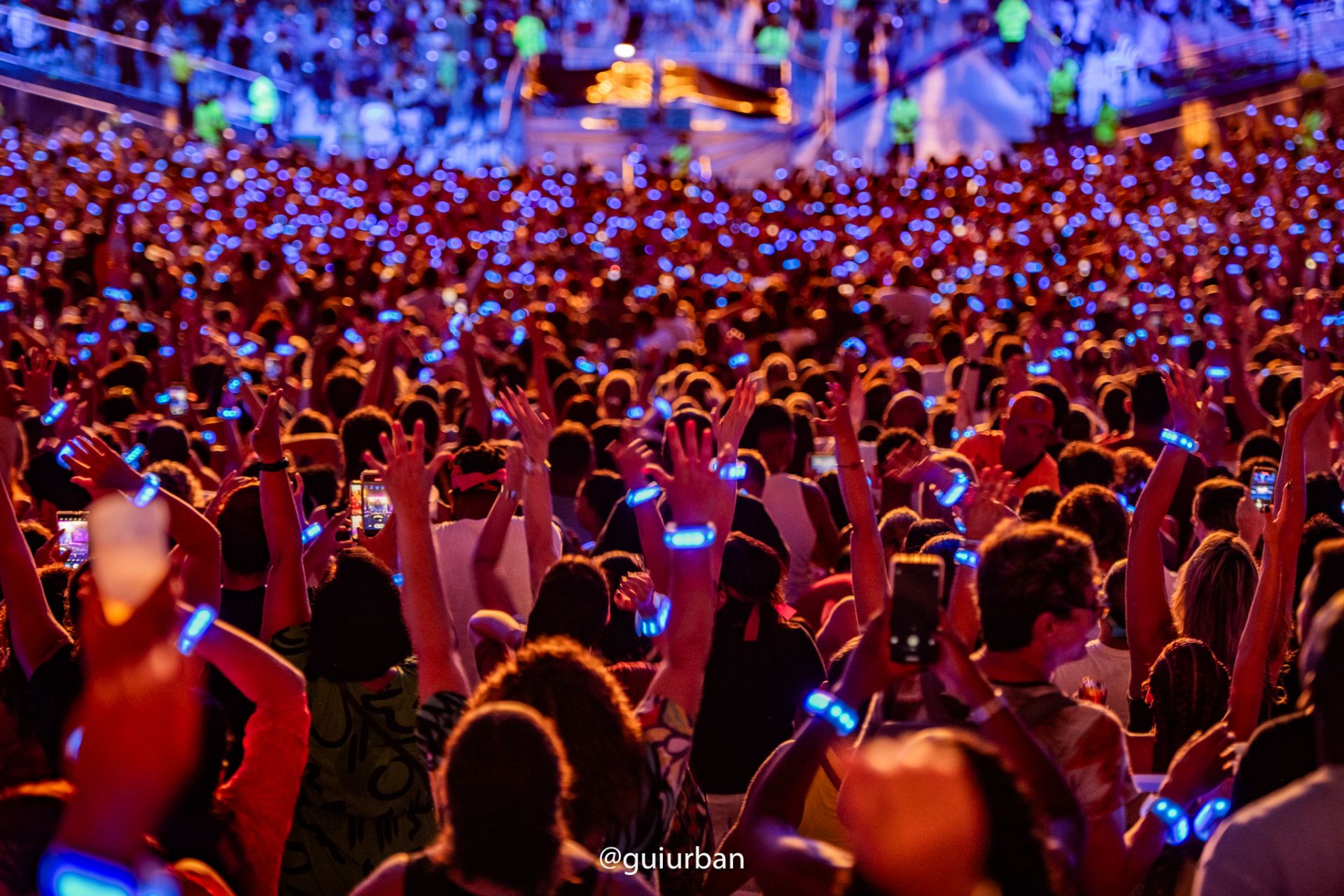
Today, Radio Controlled LED Wristbands and other forms of Wearable LED Technology are fundamental tools in a lighting designer’s kit. This technology turns every audience member into a pixel in a colossal screen. Suddenly, precise, full-color, strobing, and fading effects can sweep across 50,000 people in perfect sync with the music. When Maluma played to a hometown crowd of 54,000 in Medellín, the show—streamed globally—was defined by these spectacular, stadium-wide pulses of light. It’s a tool that provides unparalleled visual impact, creating the ultimate sense of unity and shared experience. These LED Crowd Experiences are no longer a novelty; they are a core component of modern spectacle.
Principle 3: The Narrative Arc of Light
Great lighting is not a random sequence of impressive effects; it is a choreographed story. Every lighting state, color choice, and movement is a paragraph in the show’s narrative, supporting the emotional journey of the setlist. A soft, warm glow during a ballad fosters intimacy, while sharp, percussive blasts of white light can accentuate a powerful drum fill or crescendo. The programming behind a modern tour is a meticulous, cue-by-cue process of building tension, creating moments of release, and guiding the audience’s emotional response.
This choreography extends to the crowd. With Xylobands, a designer can create waves of light that track a guitar solo across the arena, or make the entire stadium pulse with the beat of the kick drum. This visual reinforcement of the music connects the audience to the performance in a deeply subconscious way, making the sound feel visible and tangible. It’s the art of telling a story not just *to* an audience, but *through* them.
Principle 4: Designing for the Lens and the Eye
In the age of global live streams, every major tour is produced for two distinct audiences: the people in the room and the millions watching on screens. This creates a technical and creative puzzle. A lighting effect that looks stunning to the naked eye can appear blown out or flat on camera. Colors that feel vibrant in person might not render well for broadcast. Modern lighting design must serve both masters.
This is where audience lighting offers a distinct advantage for the broadcast. A dark, undifferentiated crowd can look like a void on screen. But a crowd illuminated with thousands of points of light—whether LED Bands, Concert Wristbands, or the custom LED Lanyards used at the Formula One 75th anniversary show—provides depth, texture, and energy for the camera. It frames the stage, fills the shot, and telegraphs the electric atmosphere of the venue to the viewers at home, solving the "two-audience problem" by making the live crowd a vital part of the broadcast aesthetic.
The Unified Command: From Pixels to Panorama
Ultimately, the goal of modern arena and stadium lighting design is to achieve a unified, 360-degree spectacle. It’s about erasing the boundary between the stage and the seats. By combining artist-focused lighting, architectural enhancement, and crowd-based LED Experiences, designers can create a single, immersive world. This holistic approach ensures that every element works in service of the show’s central vision.
The technology, from moving lights to LED Wearables, provides the tools. But it is the application of these principles—mastering scale, engaging the audience as a medium, telling a compelling story, and designing for all viewers—that transforms a concert into a landmark event. The canvas is always unfolding, and with the constant evolution of LED Event Technology, the palette available to designers is becoming richer and more powerful than ever before.