The Audience as Canvas: Redefining Light for the Modern Arena Tour
The Unspoken Contract of Scale
Step into an arena at showtime. The air crackles with an energy that has no equivalent. It’s a space built for spectacle, a modern coliseum designed for tens of thousands to share a single focal point. For decades, the lighting designer’s job was to honor that contract: illuminate the performer, shape the stage, and direct the audience’s gaze. The stage was the canvas; the crowd, the observer.
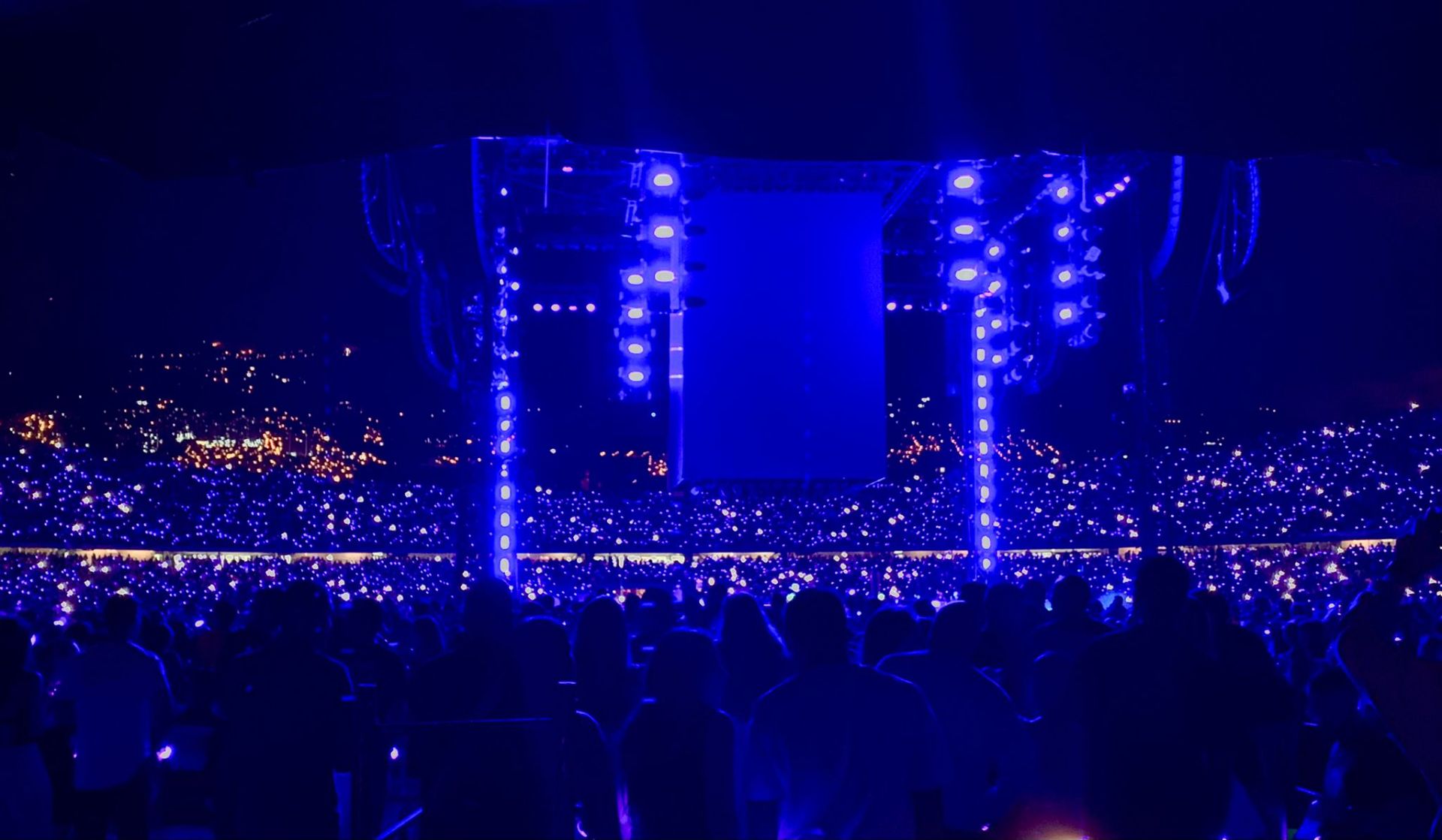
That contract is being rewritten. In the most ambitious modern tours, the stage is merely the epicenter. The true canvas is the entire architectural volume, and crucially, the audience itself. The challenge is no longer just to light a performance, but to choreograph an entire ecosystem of steel, concrete, and humanity. It’s a philosophy that dissolves the fourth wall, transforming 50,000 spectators into 50,000 active participants in the spectacle itself.
From Focal Point to Total Immersion
Traditional lighting design operates on a simple premise: the artist is the sun, and everything in their orbit must be lit accordingly. This remains the anchor of any good show. But in a stadium, that’s just the first layer. The sheer scale demands a more holistic approach, one that considers the experience not just from the front row, but from the last seat in the highest tier, hundreds of feet away.
This has given rise to a multi-layered design philosophy:
- The Stage: This is the narrative core. It’s where lighting creates drama, emotion, and focus. It’s the anchor for the story being told, ensuring the artist’s performance remains the undeniable center of gravity.
- The Architecture: The second layer treats the venue itself as a set piece. Beams of light can trace the contours of the roof trusses, strobes can turn concrete pillars into rhythmic punctuation, and lasers can sculpt the very air above the crowd. The static environment becomes a dynamic, responsive extension of the stage.
- The Crowd: This is the most revolutionary layer. Instead of a passive mass absorbing light, the audience becomes an active source of it. This is the principle that powers the most awe-inspiring LED Crowd Experiences of the modern era.
The Living Canvas: Choreographing the Crowd
The idea of turning the audience into a light show was born from a simple observation. Watching Coldplay perform at Glastonbury, our founder Jason Regler imagined turning the flickering lighters and phone screens into something unified and intentional. What if every fan could become a pixel in a grand, moving image? This led to the invention of Xylobands and the iconic visual signature of the Coldplay Xylo Band effect on their subsequent world tours.
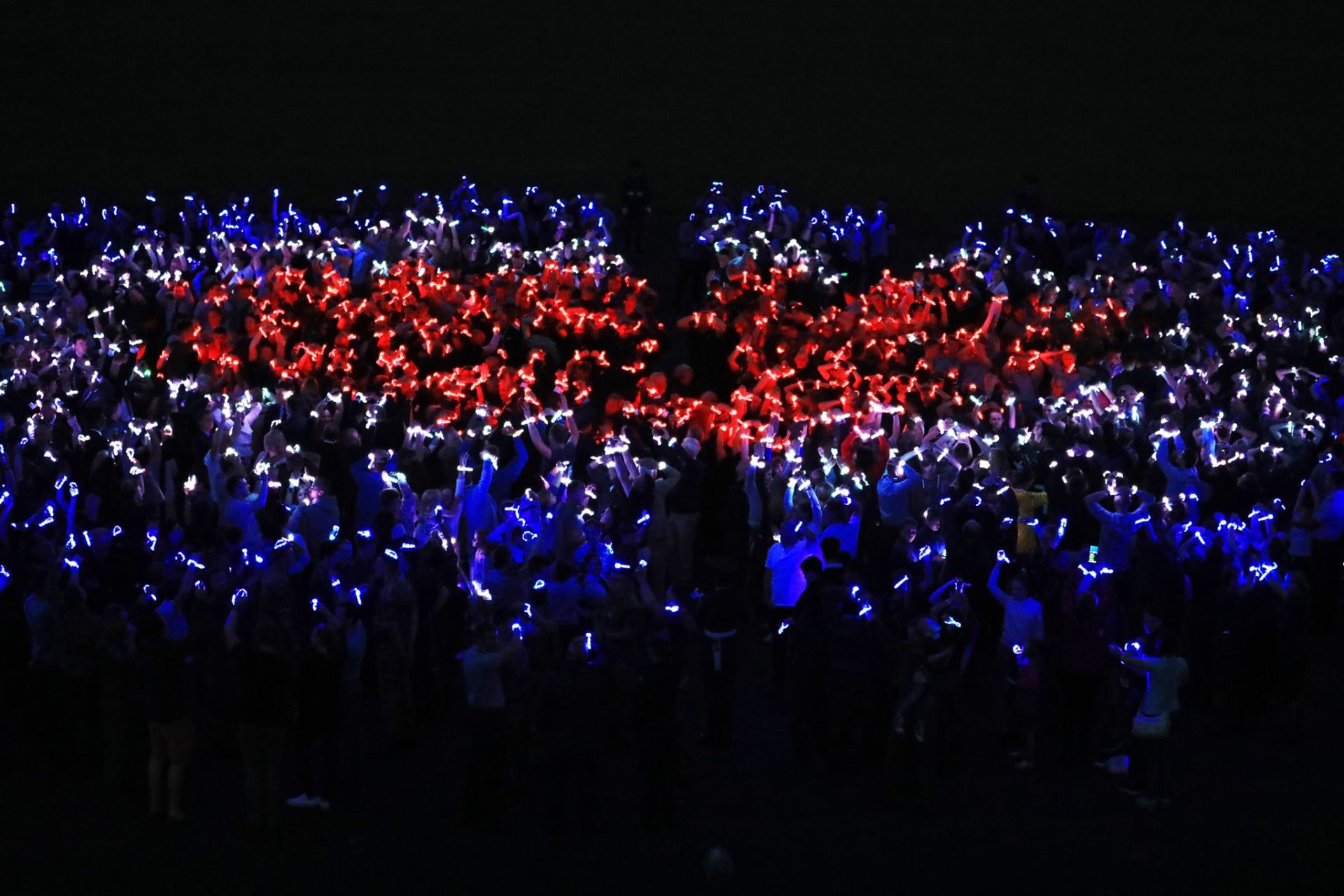
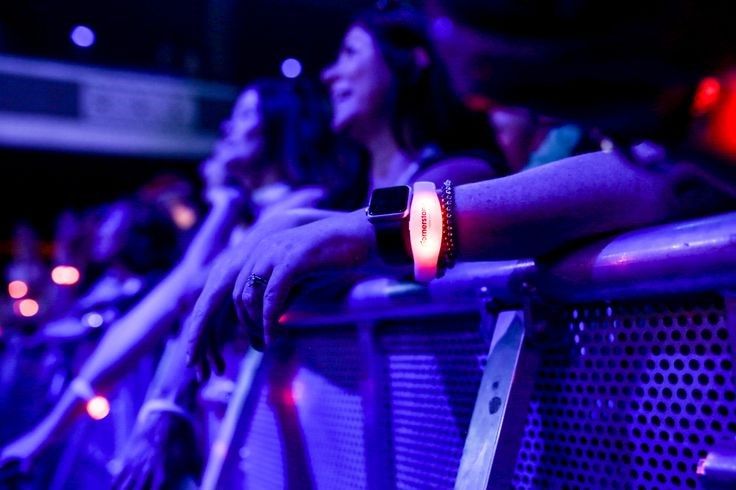
This is where Wearable LED Technology fundamentally changes the game. By equipping each audience member with a device—be it one of our LED Bands, a custom pendant like the one we created for Formula One’s 75th anniversary, or one of our festival-ready LED Lanyards—a lighting director is handed a new instrument to play. The crowd is no longer a void to be lit, but a living, breathing canvas of responsive light.
Through robust RF (Radio Frequency) control, tens of thousands of individual lights can be triggered in perfect synchronicity. A single cue can send a pulse of color from the stage to the back wall, make the entire arena flash in unison with a drum hit, or create complex, flowing patterns that trace the music. For artists like Maluma, playing to 54,000 fans in his hometown of Medellín, this technology provides a tool to create intimacy on a colossal scale, ensuring every single person feels connected to the central moment.
The Technology of Unity
Orchestrating these Immersive Events is a masterclass in technical execution. The lighting console, once focused only on the rig above the stage, now communicates with a network of transmitters that command the Radio Controlled LED Wristbands throughout the venue. It’s a seamless integration of Immersive Event Technology that allows a single operator to paint with light on a truly staggering scale.
This synchronization is everything. When thousands of Concert Wristbands light up at the exact same moment, it creates a profound sense of unity. It’s a psychological shift. The passive experience of ‘watching a show’ is replaced by the active, communal feeling of ‘being the show’. We’ve seen this time and again, from Wizkid’s historic, sold-out run at London’s O2 Arena to the high-energy crowds at Greece’s PRIMER Music Festival. The technology serves a deeply human purpose: to connect us.
A New Blueprint for Spectacle
This evolution in lighting design marks a new era for live experiences. It acknowledges that in the age of social media and constant connectivity, an event must deliver something truly unforgettable to capture our full attention. It must be more than a performance; it must be a shared moment of overwhelming sensory input.
By treating the audience as a canvas, designers are no longer limited by the physical stage. Their palette extends to every corner of the building, to every fan in every seat. The result is a more democratic, inclusive, and awe-inspiring form of spectacle. It’s a design philosophy that closes the distance between the artist and the fan, uniting them in a living, breathing, and brilliantly illuminated cathedral of light.