From Lighters to Light Shows: The Evolution of Audience Participation
The Unspoken Command
There is a moment at every great live event, a silent, unspooling thread of connection that binds thousands of strangers into a single, breathing entity. For generations, this unity was expressed in the simplest terms: a stadium wave rolling through the stands, a chant rising from the terraces, or, in the darkened intimacy of a concert hall, the spontaneous, flickering constellation of a thousand raised lighters. This was the first language of audience participation — an analog, organic expression of collective emotion. But it was just the beginning.
The arc of live event history has been a constant search for deeper, more meaningful ways to forge this connection. While the raw power of a crowd will always be the engine, technology has become the vessel, transforming the "audience" from a passive observer into an active, luminous participant. This is the story of that evolution, a journey from a simple flame to the globally synchronized light shows that define the modern spectacle.
A Spark in the Darkness
The pivot point can be traced to a single moment of inspiration. In the fields of Glastonbury, watching Coldplay perform "Fix You," our director Jason Regler was struck by the lyric, "Lights will guide you home." The sea of lighters and early cell phone screens created a powerful but chaotic image. The idea sparked: what if that light could be unified? What if every single person in the crowd could be a pixel in a grander design, a participant in a moment orchestrated for the collective good? This was the conceptual birth of Xylobands.
The idea was to take the nascent energy of the crowd and give it a central nervous system. The goal was to create a moment of pure unity, switching off the outside world and immersing thousands in a shared experience. The challenge was immense: to create a reliable, controllable, and visually stunning piece of wearable LED technology that could work flawlessly on a mass scale. When the idea was presented to Coldplay, they saw the potential, and the journey from a concept to a global phenomenon began.
The Mylo Xyloto Revolution
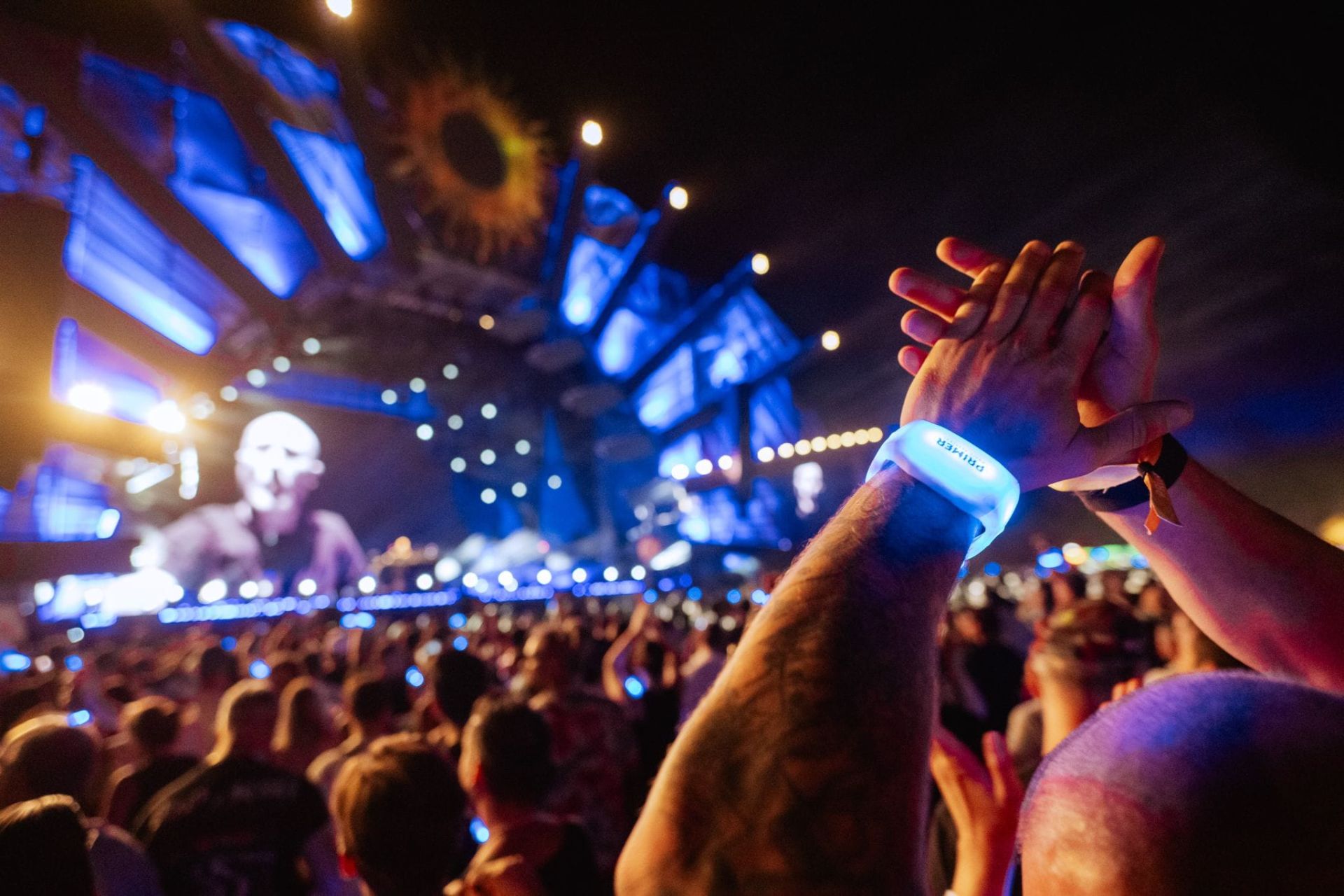
Coldplay’s 2012 Mylo Xyloto Tour was the global launchpad for this new form of immersive event technology. For the first time, an entire stadium became a canvas. The Coldplay Xylobands, as they quickly became known, were more than just concert wristbands; they were instruments. Controlled by radio frequency, the LED bands could be programmed to flash, fade, and change color in perfect sync with the music and lighting design.
The effect was revolutionary. The boundary between the stage and the seats dissolved. The audience was no longer just watching the show; they were an integral, visible part of it. This tour set a new standard for immersive events, demonstrating that technology could be used not to isolate, but to connect on an unprecedented scale. It proved that turning the crowd into a dynamic light show could amplify the emotional weight of a performance, creating unforgettable, cinematic moments.
Beyond the Arena: A New Language for Events
What began as a revolution in the music world quickly proved its versatility. The core principle — using light to unify a crowd — is a universal one, and the technology has evolved to speak a multitude of languages for different audiences and objectives.
The Broadcast Moment
In the world of television production, the studio audience is both a live participant and a backdrop for the viewer at home. For over 15 years, Xylobands has partnered with ITV on flagship shows like The Voice and Beat The Chasers. Here, radio controlled LED wristbands are used with surgical precision. Through strategic, seat-based distribution, lighting designers can create waves of color, build visual tension, and magnify applause, transforming the on-set atmosphere and translating that energy through the lens to millions watching at home. It’s a powerful tool for visual storytelling in the broadcast age.
The Roar of the Crowd
In sports, that same technology fosters unity and amplifies passion. At events like the Davis Cup — the "World Cup of Tennis" — synchronized light can paint an entire stadium in a team