The Macroscope: A New Framework for Stadium and Arena Lighting
From Stage to Spectrum: Rethinking Light in the Age of the Arena
An arena tour is more than a concert; it’s a temporary city. For a few hours, tens of thousands of people converge, bringing with them an immense collective energy. The challenge for any lighting designer or tour producer is how to harness that energy and paint a story on a canvas of unprecedented scale. Traditional stage lighting, focused solely on the performers, is no longer enough. To create truly immersive events, we must think bigger. We must treat the entire stadium—from the highest truss to the furthest seat—as a single, programmable volume.
This is the macroscope view: a framework where every element within the venue becomes a potential pixel in a grand, architectural-scale narrative. It’s a methodology that moves beyond simply illuminating artists and instead focuses on choreographing the entire sensory environment of the space. It’s not just about what happens on stage; it’s about what happens in the stands, in the air, and in the shared experience of 50,000 people.
The Three Pillars of Macro-Scale Lighting Design
To successfully execute a lighting design at the stadium level, we need to expand our definition of a “lighting fixture.” It’s no longer just about PAR cans and moving heads. In the macroscope model, the key components are the stage, the structure, and the crowd itself.
1. The Stage as the Focal Point
The stage remains the anchor of the visual experience. It’s the narrative’s nucleus, the place where the artists command attention. But in a stadium context, the stage design must be bold and scalable. It needs to hold its own against the vastness of the surrounding space. This is where high-output fixtures, massive LED screens, and innovative scenic elements come into play. The goal is to create a powerful central image that reads clearly from every angle, from the front row to the back of the upper bowl. It’s the campfire around which the entire temporary city gathers.
2. The Structure as the Skeleton
The architectural lines of the arena or stadium provide a ready-made canvas. The trusses, catwalks, delay towers, and even the roof structure itself are all opportunities to extend the design. By strategically placing fixtures along these lines, you can sketch a larger visual story that frames the stage and envelops the audience. This approach transforms the cold, functional hardware of the venue into an active part of the show’s aesthetic. Suddenly, a sterile concrete bowl becomes a dynamic, breathing environment. It adds depth, dimension, and a sense of architectural grandeur that amplifies the scale of the performance.
3. The Crowd as the Canvas
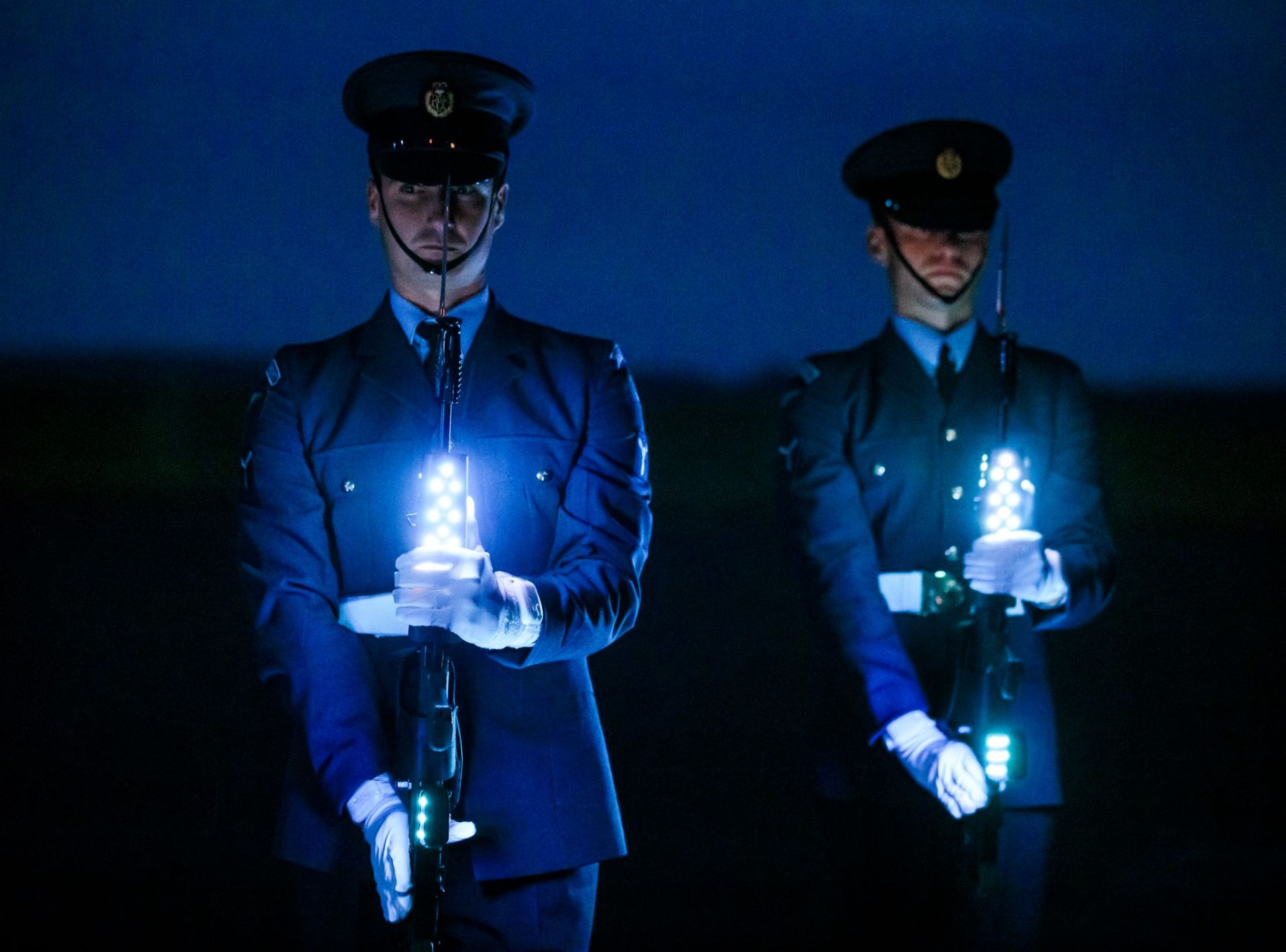
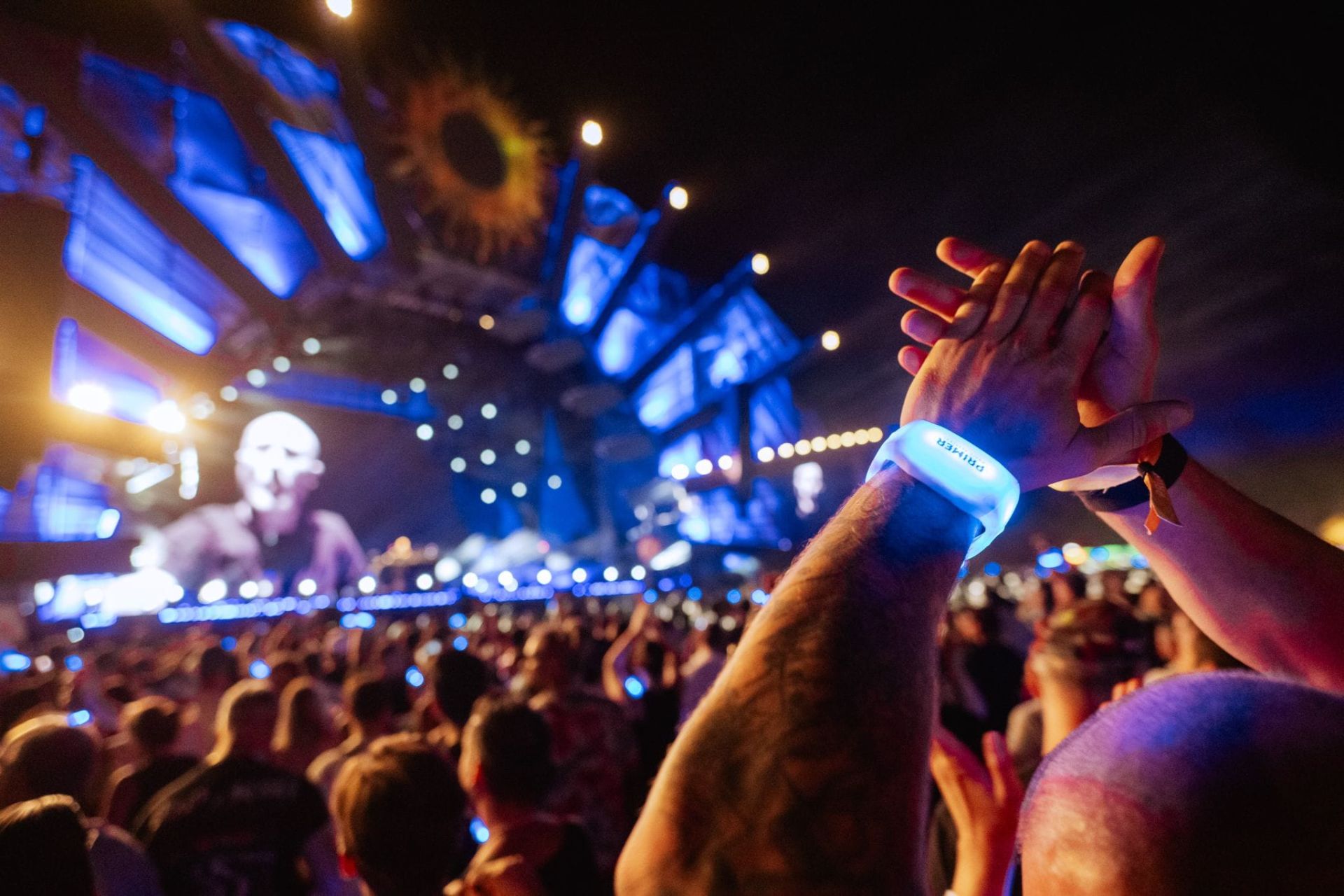
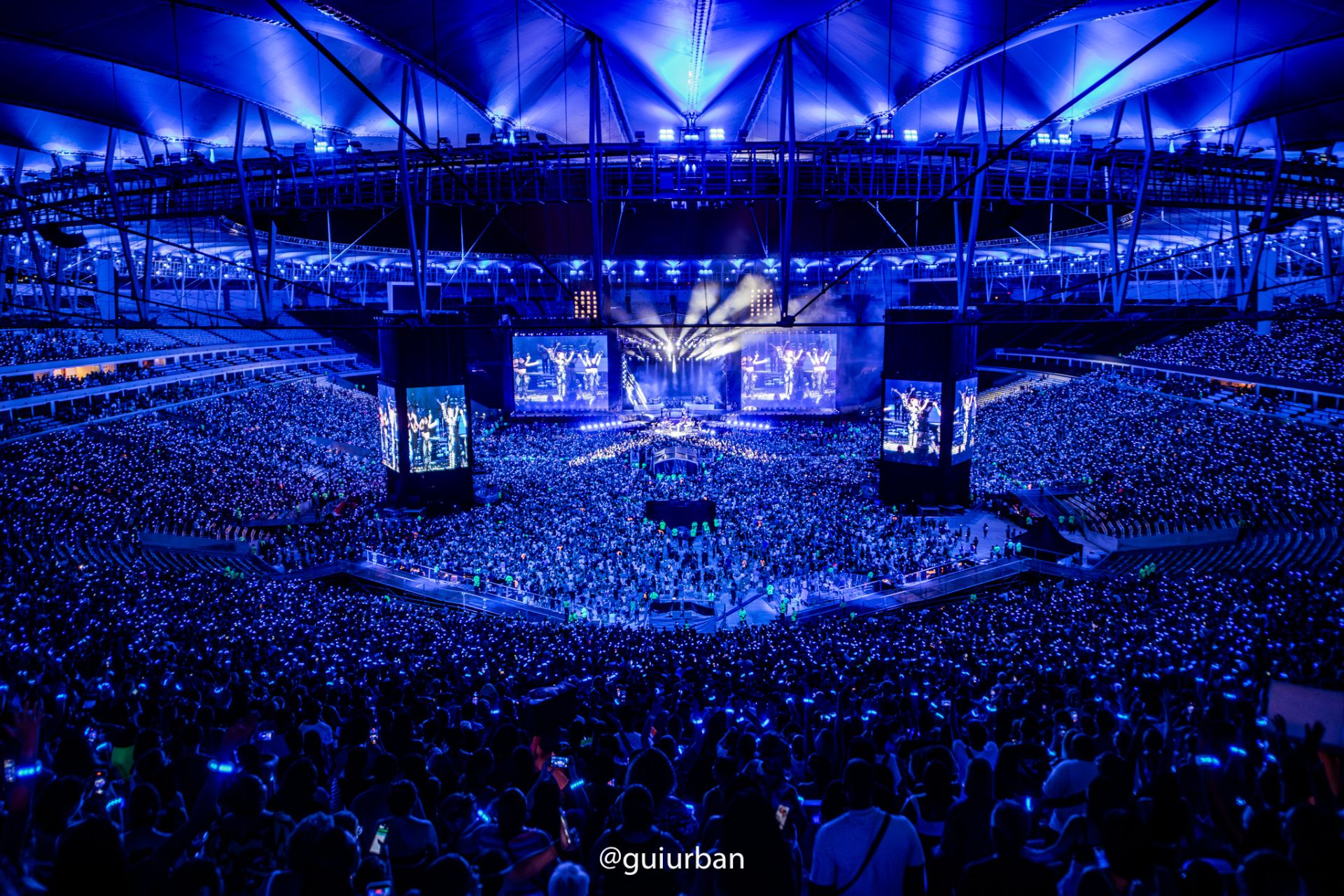
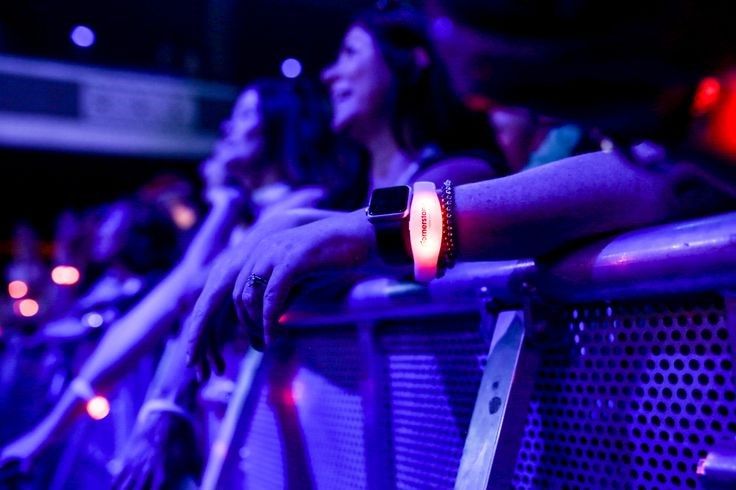
This is the most transformative and often overlooked element. The audience is not a passive observer; they are a living, breathing part of the show’s environment. With the advent of wearable LED technology, the crowd itself becomes the most dynamic and high-resolution lighting element in the entire venue. By deploying radio controlled LED wristbands, or LED Lanyards as we did for the Formula One 75th Anniversary event, you can turn 50,000 individual points of light into a single, synchronized canvas.
This technique fundamentally changes the relationship between the artist and the audience. It dissolves the barrier between the stage and the stands, creating a truly unified space. We’ve seen this on a massive scale with artists like Coldplay, where Coldplay Xylobands have become a signature part of their stadium shows, and at events like PRIMER Music Festival in Greece. The effect is profound, turning a collection of spectators into a cohesive visual organism, pulsating with the energy of the music. These LED crowd experiences are no longer a novelty; they are a core component of modern, large-scale tour design.
Choreographing the Unseen: The Role of Control and Synchronization
The magic of the macroscope framework lies in its synchronization. Tying these three pillars together—stage, structure, and crowd—requires a robust and sophisticated control system. The lighting director becomes a conductor, orchestrating a symphony of light that flows seamlessly across the entire venue. This isn’t just about triggering cues; it’s about creating a fluid, narrative-driven experience.
For a show to resonate on an epic scale, every photon must have a purpose. The lone spotlight on a singer, the sweep of beams across the roof, and the synchronized pulse of 50,000 concert wristbands must all feel like they are part of the same, unified creative vision.
The complexity of this task cannot be understated. It demands flawless integration of RF, DMX, and other networking protocols, all working in perfect harmony. When Maluma played to a hometown crowd of 54,000 in Medellín, the show was broadcast live to over 240 countries. In a scenario like that, where the at-home audience is just as important as the live one, the lighting must be "Engineered for the Lens." The spectacle must translate through a camera without losing its impact, and crowd-based lighting is a powerful tool for conveying the sheer scale and energy of the event to viewers worldwide.
Beyond the Spectacle: Building Connection at Scale
Ultimately, the goal of any great tour design is to create connection. The macroscope approach uses the vastness of the stadium not as a barrier, but as an opportunity to foster a deeper sense of community. When an entire stadium lights up in a single colour, it creates a powerful moment of unity. For that one instant, 80,000 people are part of the same shared experience, a single tribe brought together by music and light.
By expanding our view to encompass the stage, the structure, and the crowd, we move beyond simply lighting a performance. We begin to design an environment, choreograph an experience, and build a temporary world. We give fans more than just a show; we give them a role to play. In the grand theatre of the stadium, every single person can become a part of the light, proving that even in the biggest of spaces, the most powerful moments are the ones we share.