The Fourth Wall: An Oral History of Audience Participation
From Chorus to Crowd: The Ancient Roots of Audience Interaction
The desire to be part of the show is as old as performance itself. In the amphitheaters of ancient Greece, the chorus was not merely a group of performers; they were the voice of the community, reacting, commentating, and guiding the audience’s emotional journey. They were, in a sense, the original form of audience participation—a bridge between the actors on stage and the spectators in their seats. This fundamental principle, that an audience is not a passive recipient but an active participant, has echoed through the centuries.
For millennia, this interaction remained largely analogue. Audiences clapped, cheered, sang along, and, in more raucous times, threw everything from flowers to vegetables. The first significant technological shift arrived with the advent of controlled lighting, which allowed artists to direct focus and sculpt the emotional landscape of a venue. But the audience itself remained a collection of individuals, their participation a spontaneous and uncoordinated wave of human energy.
The Analogue Wave: Lighters, Singalongs, and the Dawn of Collective Expression
The mid-20th century saw the birth of the modern concert, and with it, new rituals of participation. The singalong became a centrepiece of popular music, a moment where the barrier between artist and fan dissolved into a single, unified voice. Then came a moment of accidental magic: the flicker of a single lighter in the dark during a 1969 performance by Melanie at Woodstock. What began as a practical way to cut through the darkness became a powerful symbol of solidarity and shared emotion.
The sea of flames became an iconic image of the live music experience, the first time the audience could manifest its collective feeling as a visual spectacle. This was the analogue precursor to modern immersive events, a raw, un-networked expression of unity. The advent of the mobile phone decades later updated the ritual, replacing flames with screens, but the underlying technology remained decentralized. Each light was an island, beautiful in its multiplicity but not yet a single, connected canvas.
The Digital Spark: Inventing the LED-Powered Smart Crowd
The true revolution in audience participation began with a simple question: What if every single one of those lights could be connected? What if the crowd itself could become a dynamic, controllable extension of the show’s design?
This was the vision that led to the invention of Xylobands in 2011. Inspired by watching Coldplay perform their song “Fix You,” our founder imagined transforming the audience from spectators into a living, breathing light show. The idea was to harness the power of RF (Radio Frequency) technology to create radio controlled LED wristbands that could be synchronized with the music, lighting, and video cues of a performance.
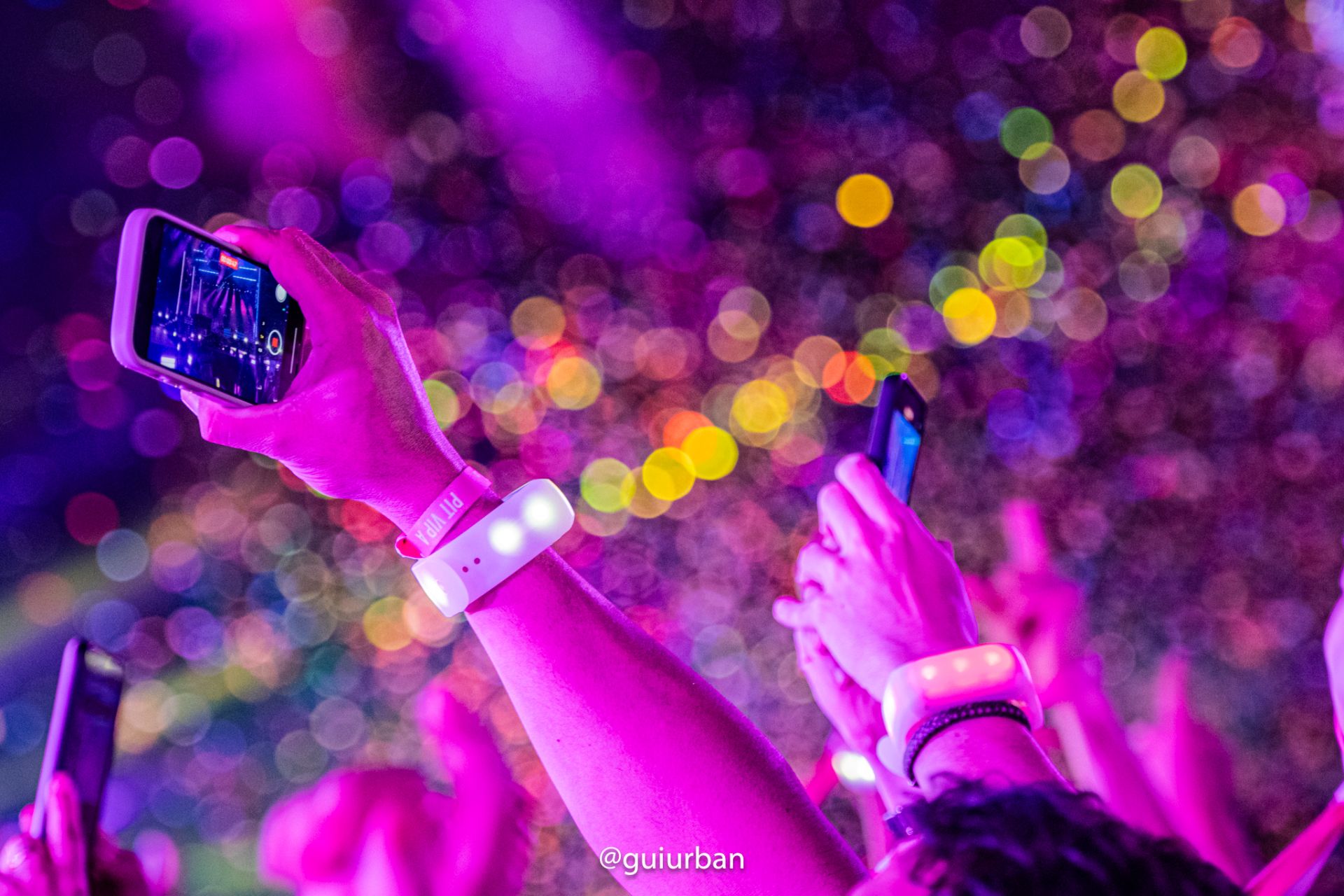
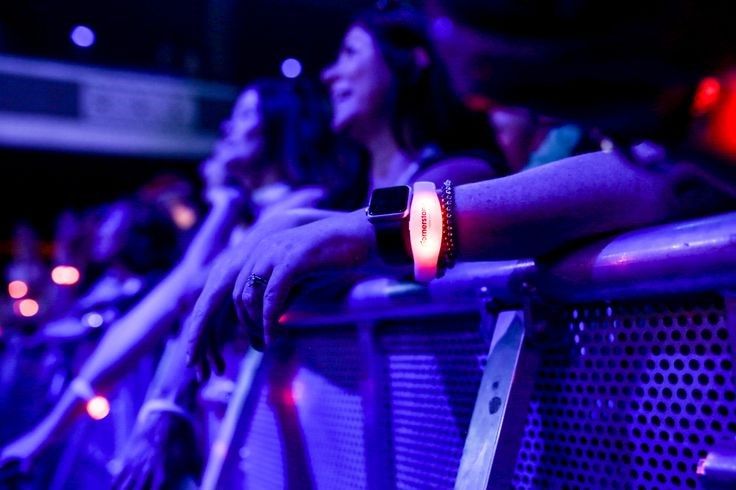
When these LED bands debuted on Coldplay’s Mylo Xyloto World Tour in 2012, they fundamentally redefined the relationship between the artist, the audience, and the environment. The crowd was no longer just watching the show; they were the show. This breakthrough in wearable LED technology turned every individual into a pixel in a vast, human canvas, capable of displaying complex patterns, sweeping colours, and explosive strobes. The era of modern LED crowd experiences had begun.
The Evolution of Immersive Event Technology
Since that first tour, the technology has evolved at a breathtaking pace, expanding far beyond its initial application in music. Today’s systems are more sophisticated, offering greater control, more nuanced effects, and a wider range of form factors.
- DMX and Infrared Control: Alongside RF, DMX and Infrared (IR) control systems now allow for even more granular and zoned lighting effects. This means a creative director can light up specific sections of a stadium, create radiating patterns from the stage outwards, or even make wristbands react to an individual’s specific location.
- Beyond the Wristband: The technology has expanded beyond the original LED bracelets. We now see LED Lanyards, glowing pendants, and even light-up LED Orbs being used to transform environments and create unique corporate event activations. For the 75th anniversary of Formula One, for example, custom Xylo Pendants were used to differentiate between hospitality tiers and create team-specific lighting effects throughout the arena.
- Festival and Broadcast Integration: At large-scale events like Greece’s PRIMER Music Festival, festival wristbands are now an essential part of the production, unifying tens of thousands of attendees. The technology has also become critical for broadcast, solving what we call the “two-show problem”—designing an experience that is equally dazzling for the audience in the venue and the millions watching at home. This is crucial for major televised events, from the Eurovision Song Contest to sporting spectacles like the Davis Cup.
The Future of Participation: Data, Personalization, and the Human Connection
We are now entering the next phase in the evolution of immersive event technology. The focus is shifting from pure spectacle to more personalized and interactive experiences. Today’s LED wearables are not just receivers of a signal; they are becoming part of a two-way data stream. This opens up a world of possibilities:
By understanding crowd movement, density, and energy levels in real-time, event producers can make smarter decisions about everything from safety and security to show pacing and content delivery.
Imagine concert wristbands that change colour based on your proximity to a certain stage at a festival, or corporate event lanyards that guide you to your next session. Imagine voting in a reality show like Beat The Chasers by simply raising your wrist, with the collective result displayed instantly across the entire studio audience.
This is not science fiction; it is the near future of live events. The technology that began with a flickering flame at Woodstock has evolved into a sophisticated tool for storytelling, connection, and collective joy. From the Greek chorus to the Coldplay Xylobands phenomenon, the goal has always been the same: to break down the fourth wall and unite thousands of individuals into a single, shared moment. The canvas is no longer the stage; it’s the entire room. And every person in it is part of the art.